This article is part of our complete travel eSIM guide for Pakistani travellers.
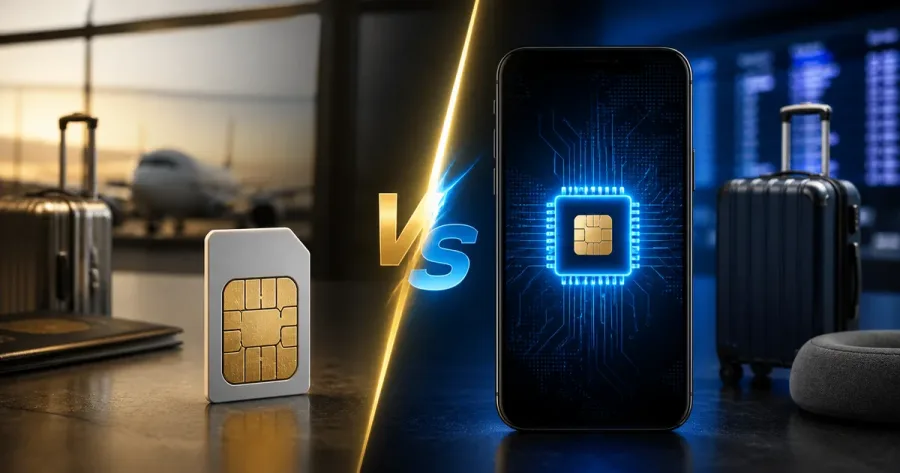
When you travel abroad, you have three ways to get data: pay your home carrier's roaming rates, buy a local physical SIM at your destination, or install a travel eSIM before you go. This article compares the eSIM and physical-SIM routes head to head so you can decide what suits your trip.
The quick answer
For most international travellers in 2026, a travel eSIM wins on convenience, setup speed and keeping your home number — while a local physical SIM can occasionally be cheaper for very long stays or if you need a local phone number. Here's the full breakdown.
| Factor | Travel eSIM | Physical local SIM |
|---|---|---|
| Setup process | Can be installed before travel when the plan permits | Often arranged after arrival; shop and ID requirements vary |
| Keep home number | Yes (dual SIM) | Only if your phone has two slots |
| Risk of loss | None — it's digital | Tiny card, easy to lose/swap |
| Local phone number | Usually data-only | Yes |
| Connection after landing | Depends on activation, device settings and local network availability | After purchase and activation, subject to the local network |
Which Is More Convenient to Set Up — eSIM or Physical SIM?
An eSIM can be installed at home over Wi-Fi when the selected plan permits, avoiding a physical SIM swap. Connection after arrival still depends on the activation rule, device settings and local network availability. A physical SIM may require finding a vendor, meeting local identification rules and swapping cards.
Cost
Travel eSIMs are priced per data bundle and are dramatically cheaper than carrier roaming. Against a local physical SIM, prices are usually comparable for short and medium trips. For very long stays (multiple months in one country) a local post-paid contract can edge ahead, but for trips of a few days to a few weeks the eSIM is competitive and far less hassle.
Keeping your home number
Because an eSIM is a second digital line, your physical home SIM stays in the phone. You keep receiving calls, SMS and crucially the banking OTPs that many Pakistani and international banks send for online payments. Swap to a physical foreign SIM in a single-slot phone and you lose access to your home number entirely for the trip.
Security
An eSIM cannot be physically removed from your phone, which makes it harder for a thief to pop out your SIM and hijack your number. There's also nothing to misplace. Physical SIMs are tiny and the ejector-pin ritual at a busy airport is exactly where cards get dropped or mixed up.
When Does a Physical SIM Still Make Sense?
- You need a local phone number for calls, deliveries, or local app verification.
- You're staying many months and want a local contract.
- Your phone doesn't support eSIM (older or some region-locked models).
When an eSIM is the better choice
- Short and medium trips — business, tourism, family visits, Umrah.
- You want to install a plan before travel and reduce airport SIM administration.
- You need to keep your home number for OTPs and calls.
- You visit multiple countries on one trip — buy a regional plan instead of several SIMs.
If that sounds like you, browse simless.pk travel eSIM plans for 190+ destinations and install before you fly.
Frequently Asked Questions
Is an eSIM cheaper than roaming?
Yes, significantly. Carrier roaming is billed at premium per-megabyte rates, while a travel eSIM gives you a fixed prepaid data bundle — usually a fraction of the roaming cost for the same usage.
Can I use an eSIM and a physical SIM at the same time?
Yes. Modern phones support Dual SIM, so your physical home SIM and the travel eSIM run together. You keep your home number for calls and OTPs while the eSIM carries data.
Do eSIMs work in multiple countries?
Yes. Many providers sell regional and global eSIM plans that cover dozens of countries on a single profile, which is ideal for multi-country trips.
Is eSIM more secure than a physical SIM?
In one practical sense, yes — an eSIM can't be physically removed, so a thief can't pop it out to take over your number, and there's no tiny card to lose.
Choose the option that removes the most friction
An eSIM is useful when you want to prepare at home and keep your physical SIM in the phone for calls or banking messages. A physical SIM can still suit a traveller who needs a local number or prefers in-person help. Neither option is automatically better; the right choice depends on the device, plan and trip.
The GSMA’s eSIM overview is a helpful technical reference. Check the phone maker’s compatibility information and the selected plan’s features before treating “eSIM” as a complete answer.
Source used for this section: GSMA eSIM overview. Reviewed 12 August 2026. Information can change, so confirm the current plan card and ordering details with the WhatsApp team before paying.
Before purchasing: a quick accuracy check
This article is practical guidance, not a promise of network speed, availability or a particular operator. Plan prices, allowance, activation timing, partner networks and fair-use conditions can change. Check the selected offer with the WhatsApp team before paying, and keep the order conversation and installation instructions until the eSIM is working.
Install while connected to Wi-Fi. Your device needs eSIM support, an unlocked carrier status and room for another profile. On arrival, select the travel eSIM for mobile data and follow the activation instructions provided with that plan.
Our verification method explains how Simless reviews catalogue information and updates editorial pages. Use the device compatibility checker before buying.